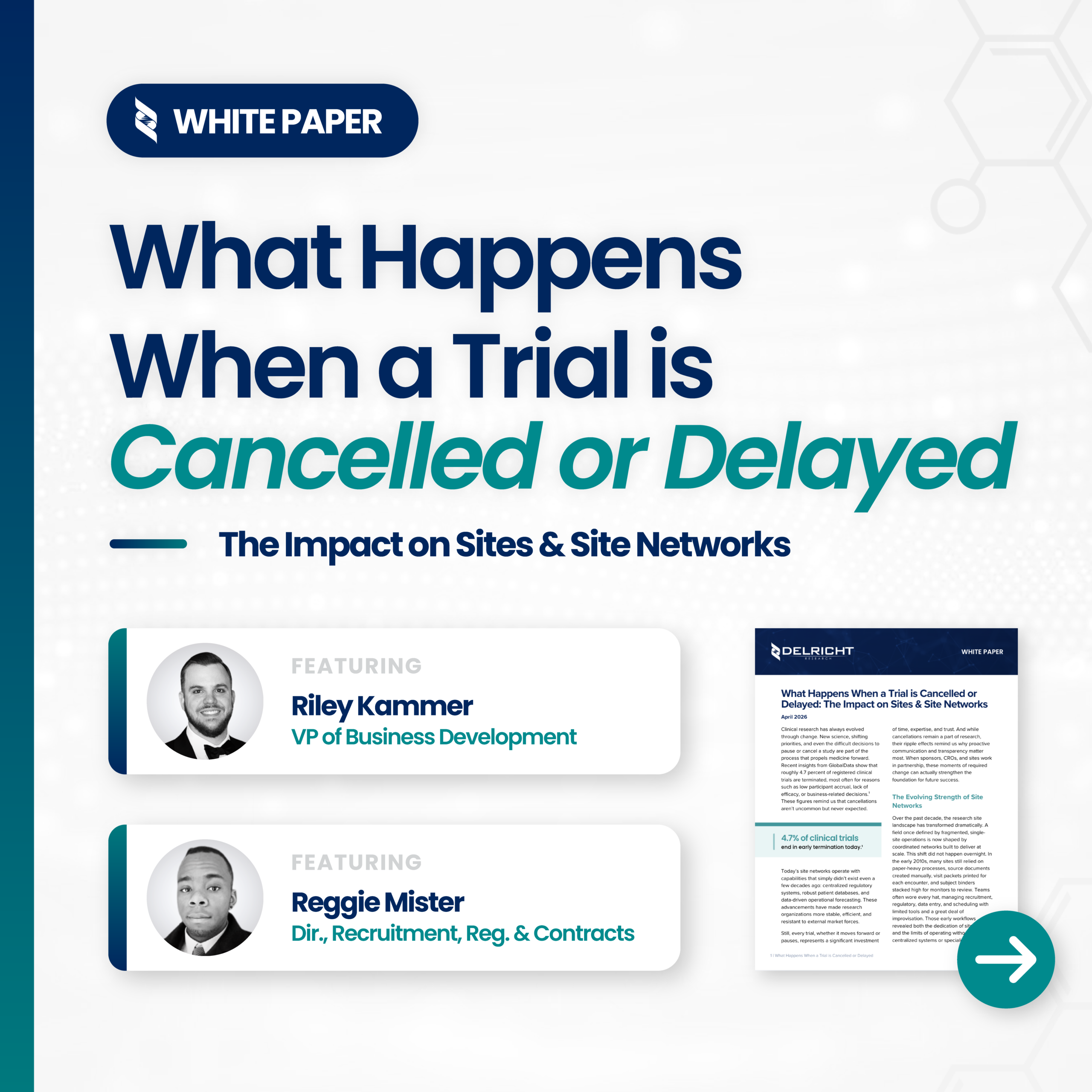
What Happens When a Trial is Cancelled or Delayed: The Impact on Sites & Site Networks
What Happens When a Trial is Cancelled or Delayed: The Impact on Sites & Site Networks
Clinical research has always evolved through change. New science, shifting priorities, and even the difficult decisions to pause or cancel a study are part of the process that propels medicine forward. Recent insights from GlobalData show that roughly 4.7 percent of registered clinical trials are terminated, most often for reasons such as low participant accrual, lack of efficacy, or business-related decisions.¹ These figures remind us that cancellations aren’t uncommon but never expected.
Today’s site networks operate with capabilities that simply didn’t exist even a few decades ago: centralized regulatory systems, robust patient databases, and data-driven operational forecasting. These advancements have made research organizations more stable, efficient, and resistant to external market forces.
Still, every trial, whether it moves forward or pauses, represents a significant investment of time, expertise, and trust. And while cancellations remain a part of research, their ripple effects remind us why proactive communication and transparency matter most. When sponsors, CROs, and sites work in partnership, these moments of required change can actually strengthen the foundation for future success.
The Evolving Strength of Site Networks
Over the past decade, the research site landscape has transformed dramatically. A field once defined by fragmented, single-site operations is now shaped by coordinated networks built to deliver at scale. This shift did not happen overnight. In the early 2010s, many sites still relied on paper-heavy processes, source documents created manually, visit packets printed for each encounter, and subject binders stacked high for monitors to review. Teams often wore every hat, managing recruitment, regulatory, data entry, and scheduling with limited tools and a great deal of improvisation. Those early workflows revealed both the dedication of site staff and the limits of operating without centralized systems or specialized support.
These lessons became the catalyst for modernization. As trial complexity grew, the industry embraced electronic source, shared regulatory platforms, clearer role delineation, and scalable workflows that could support multiple protocols simultaneously. Today, regulatory teams can manage numerous electronic site files remotely. Coordinators are cross-trained across indications, allowing them to shift quickly as timelines move. Finance and contracting groups operate with the kind of rigor and forecasting once reserved for larger clinical organizations.
This evolution has created a more resilient research infrastructure, one designed to better withstand fluctuations in trial pipelines and global market pressures. Modern site networks are more capable of navigating change than ever before, with systems in place to preserve patient engagement and maintain operational continuity when trials pause or shift. But resilience does not eliminate impact.
Even the most capable networks feel the effects of cancellations and sudden reprioritizations. When trials change course, the impact is immediate and tangible. A protocol revision, portfolio shift, or early data signal can require rapid adjustments to staffing, scheduling, and resource allocation across active studies. While today’s networks can respond with greater coordination, reassigning visits, postponing submission, or redistributing resources, these actions reflect disciplined planning, not an unlimited capacity to absorb disruption at every turn.
This is institutional learning in practice. Every trial, whether it proceeds or pauses, contributes to more refined contingency plans, better forecasting, and stronger systems required in an unpredictable environment. At the same time, repeated unpredictability introduces strain. Research sites cannot endlessly flex without consequence, particularly when changes occur late in the lifecycle or without clear forward visibility.
For investigators, this balance is especially delicate. Many block dedicated research time around projected enrollment windows, and when studies pause unexpectedly, that time must be absorbed back into clinical practice or other trials. Seasoned investigators may view this as part of the research landscape, but for newer investigators, repeated cancellations can make the process feel uncertain and difficult to sustain. A recent FDA survey found that more than half of investigators conducting FDA-regulated drug trials were “one-and-done,” citing workload balance and limited opportunity as key reasons.²
This unpredictability has broader implications. It raises the barrier to bringing new investigators into research and threatens the long-term capacity of the ecosystem itself. Sustaining investigator engagement, and continuing to expand the pool of experienced sites, requires predictability where possible, transparency when change is necessary, and shared accountability across sponsors, CROs, and sites.
Site maturity has changed what’s possible, but it has also clarified what’s at stake. When trials shift, the effects extend beyond systems and schedules, shaping the experience of the people who make research possible.
Patients at the Center of Stability
Behind every protocol are participants; people who have rearranged schedules, made childcare plans, or placed personal trust in a study team. When a trial pauses or cancels, the effect on patients is often emotional before it is logical.
Studies on clinical scheduling behavior show that when appointments are rescheduled by the clinic rather than at the patient’s request, no-show rates increase by 6.2 percent, underscoring how externally driven changes can subtly erode engagement.³ In that light, proactive communication means measurable risk mitigation for participant retention.
That’s why modern site networks invest so heavily in patient communication and relationship management. From pre-screening to retention, research teams focus on transparency, empathy, and ongoing engagement. When cancellations occur, that same infrastructure helps maintain connection and preserve trust for future opportunities. As Reggie Mister, Director of Recruitment, Regulatory & Contracts at DelRicht Research, explains, “Patients appreciate transparency. The more upfront we can be about shifting timelines, the more trust we preserve for future studies.”
“Patients appreciate transparency. The more upfront we can be about shifting timelines, the more trust we preserve for future studies.”
— Reggie Mister, Director of Recruitment, Regulatory, & Contracts
Sponsors who share early visibility into potential delays enable sites to have honest conversations with patients. Even a brief heads-up allows coordinators to manage expectations, reduce confusion, and keep participants informed. This transparency protects individual relationships and reinforces community trust in research as a whole.
Strategic and Financial Readiness
Every site views a trial not only as a scientific endeavor but also as an operational investment to hopefully fuel additional research. Startup activity, regulatory submissions, contract negotiations, and training represent significant effort before the first patient ever enrolls. When cancellations happen late in this process, they create opportunity costs that can be difficult to recoup.
As clinical trials become increasingly global, overlapping studies that target similar patient populations can further strain recruitment and performance, and early identification of competitive risk is now essential to feasibility accuracy and resource planning. Yet even with careful forecasting, conditions can shift quickly. Sites answer feasibility questionnaires with the best information available at that moment, but moving enrollment periods, delayed startup activities, or supply constraints can rapidly change the enrollment environment. These shifts, often outside the site’s control, complicate the very projections sponsors rely on for enrollment planning.⁴ As a result, ongoing evaluation of competitive risk is fundamental to safeguarding resources and protecting the viability of a site’s operational investments. Riley Kammer, Vice President of Business Development at DelRicht Research, emphasizes the importance of meeting sponsor expectations, stating, “We evaluate every opportunity through the lens of operational fit and patient access, ensuring we deliver on what matters most to sponsors. Selectivity is part of our strategy; we focus on trials where our sites are positioned to deliver strong enrollment, data quality, and collaboration.
“We evaluate every opportunity through the lens of operational fit and patient access, ensuring we deliver on what matters most to sponsors. Selectivity is part of our strategy; we focus on trials where our sites are positioned to deliver strong enrollment, data quality, and collaboration.”
— Riley Kammer, Vice President of Business Development
Here again, professionalization has changed the conversation. Centralized infrastructure, milestone-based staffing, and diversified portfolios help balance financial pressures. Networks now manage trial pipelines with the same sophistication as sponsors, using forecasting models, performance dashboards, and cross-functional planning to maintain continuity across programs.
For sponsors, this maturity means stronger predictability and lower risk. At the same time, it highlights a growing truth within today’s research ecosystem: predictability must run both ways. Sponsors understandably seek more reliable enrollment performance, but sites need the same consistency in activation timelines, supply readiness, and enrollment windows to deliver on those expectations. Well-structured site networks can scale up or down in response to portfolio adjustments but that responsiveness is most effective when built on transparent communication and realistic planning assumptions.
The Power of Transparency and Early Communication
Every organization in this field understands that cancellations are sometimes unavoidable. FDA feedback, shifting development priorities, or emerging data can all change timelines. But what defines strong partnerships isn’t whether these shifts occur; it’s how they’re handled.
When sponsors and CROs communicate early and clearly about potential risks, it empowers sites to make timely decisions: to throttle recruitment, reallocate coordinators, or pause training before resources are lost. Even informal updates, “This program is under review; hold on patient scheduling,” can make a significant difference.
Encouragingly, sponsor transparency is improving. The percentage of terminated drug trials with no stated reason fell from 27.4 percent in 2010 to just 8.7 percent in 2021, reflecting measurable progress across the industry.¹ That improvement signals a broader cultural shift toward partnership and accountability, one that sites deeply value.
Shared Strategies for Resilience
What sites can do:
– Maintain flexible staffing models and cross-trained teams that can pivot as timelines change.
– Diversify trial portfolios across indications and sponsors to absorb short-term shifts.
– Leverage centralized systems for regulatory, contracting, and finance to reduce redundant effort.
– Continuously analyze sponsor performance data to forecast stability and alignment.
What sponsors and CROs can do:
– Communicate early about any potential portfolio or protocol shifts.
– Preserve vetted site documentation and training to reduce startup redundancy in future trials.
– Offer milestone-based compensation or cost-recovery clauses for late-stage cancellations.
– Recognize sites that demonstrate adaptability and partnership consistency.
These practices, when implemented collaboratively, turn inevitable cancellations into opportunities for mutual learning and improvement.
A Shared Path Forward
Trial cancellations are part of a complex, adaptive system that is constantly learning. What defines the strength of that system is the way sponsors, CROs, and sites respond together.
Today’s professionalized site networks have the capability, structure, and foresight to weather change with confidence. What they need most from their partners is visibility and collaboration.
When we align on transparency, shared planning, and patient-first communication, even an unexpected stop can become a step forward. Each adjustment refines our collective ability to deliver trials faster, safer, and more predictably, and that benefits every stakeholder in the ecosystem.
Resilient partnerships create resilient research. Together, we can ensure that every study, whether it reaches completion or changes course, continues to move medicine forward.
References
1. Fultinavičiūtė U, Maragkou I. Trial termination analysis unveils a silver lining for patient recruitment. Clinical Trials Arena. Published October 23, 2022. https://www.clinicaltrialsarena.com/features/clinical-trial-terminations/?cf-view
2. Corneli A, Pierre C, Hinkley T, et al. One and done: Reasons principal investigators conduct only one FDA-regulated drug trial. Contemporary Clinical Trials Communications. 2017;6:31-38. doi:https://doi.org/10.1016/j.conctc.2017.02.009
3. Liu J, Xie J, Yang KK, Zheng Z. Effects of Rescheduling on Patient No-Show Behavior in Outpatient Clinics. Manufacturing & Service Operations Management. 2019;21(4):780-797. doi:https://doi.org/10.1287/msom.2018.0724
4. Rajadhyaksha V. Conducting Feasibilities in Clinical Trials: An Investment to Ensure a Good Study. Perspectives in Clinical Research. 2024;1(3):106. https://pmc.ncbi.nlm.nih.gov/articles/PMC3146075/
All News