Exploring Combination Therapy for Vitiligo: Ruxolitinib Cream and NB-UVB Phototherapy
Exploring Combination Therapy for Vitiligo: Ruxolitinib Cream and NB-UVB Phototherapy
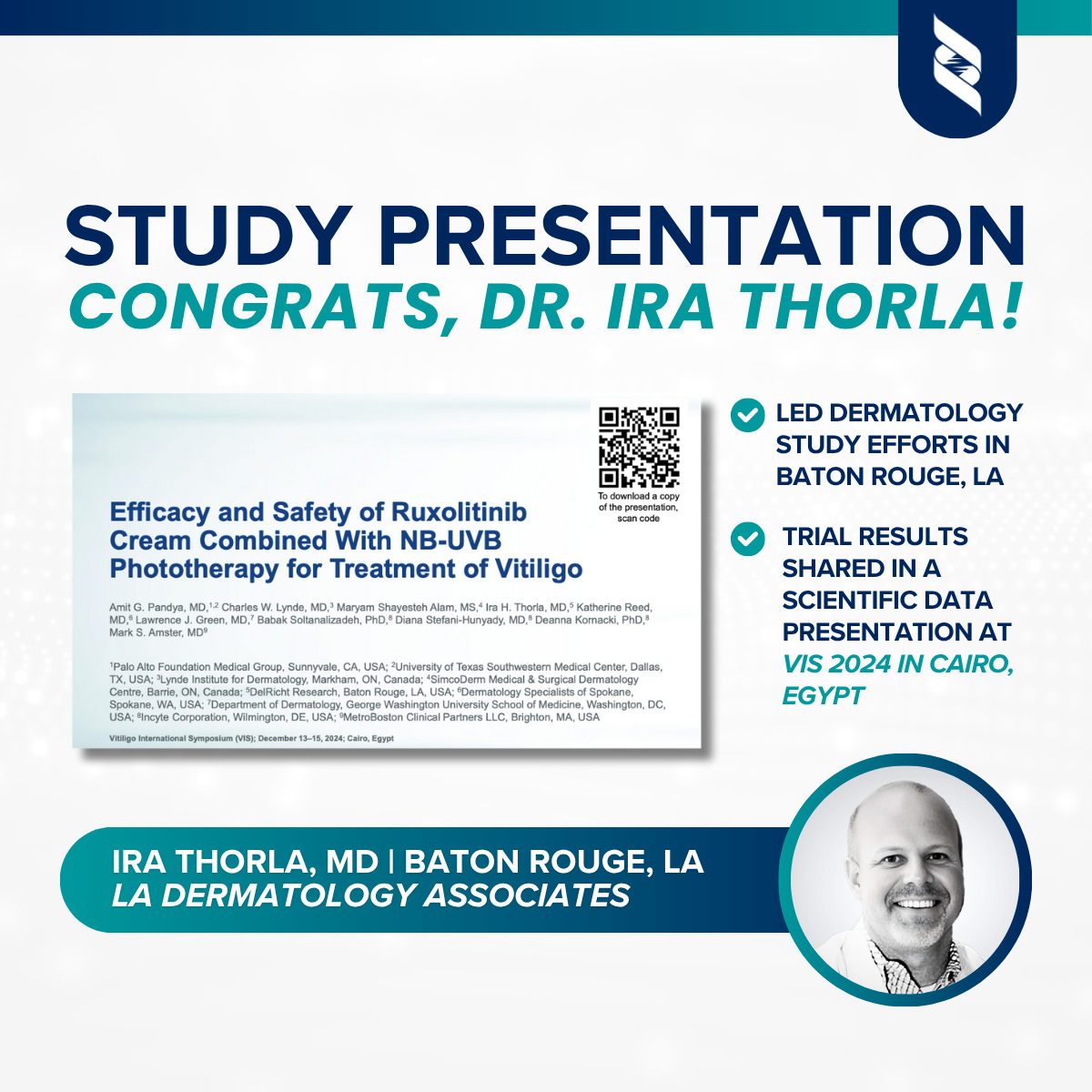
Vitiligo is a chronic skin condition that can significantly affect patients’ confidence and quality of life, especially when it begins at a young age. In a recent open-label study, Dr. Ira Thorla, a dedicated investigator at Louisiana Dermatology Associates in Baton Rouge and long-standing partner of DelRicht Research, contributed to examining the safety and potential benefit of a new combination treatment: ruxolitinib cream paired with narrowband ultraviolet B (NB-UVB) phototherapy.
Study Overview
This two-part study enrolled patients aged 12 and older with nonsegmental vitiligo covering less than or equal to 10% of their body surface area (BSA). All participants began treatment with ruxolitinib cream 1.5%, applied twice daily, for the first 12 weeks. Following this period, patients were assessed based on their Total Vitiligo Area Scoring Index (T-VASI) improvement. They were then either continued on ruxolitinib cream alone or began a combination regimen with NB-UVB phototherapy three times weekly through Week 48.
The primary goal was to measure the percentage change in T-VASI at Week 48. Secondary objectives included evaluating facial VASI (F-VASI), safety outcomes, and the proportion of patients achieving key repigmentation milestones such as 50%, 75%, or 90% improvement.
Key Findings and Clinical Considerations
The study found no new safety concerns with the addition of NB-UVB or continued use of ruxolitinib cream, offering reassurance around the tolerability of both treatment approaches. While the overall efficacy data was inconclusive, the findings shed light on several patient-specific factors that could guide future treatment decisions:
– Early nonresponders showed potential benefit from combination therapy. Some patients who didn’t initially respond to monotherapy at 12 weeks went on to achieve 50% or greater repigmentation after 9 months of combined treatment.
– Monotherapy still held promise for some. Among those who stayed on ruxolitinib cream alone, 6 of 20 completed the full treatment period, demonstrating that continued improvement may occur even without the addition of phototherapy.
– Treatment response timelines vary. The study emphasized that Week 12 may be too early to label a patient as a non-responder. Many slow responders continued to show progress over time, suggesting a need for more personalized decision-making.
Study design limitations warrant further research. Without a comparator arm of patients receiving only phototherapy from the start, or continuing ruxolitinib alone beyond 12 weeks in all nonresponders, definitive conclusions on treatment superiority remain elusive.
Continuing Progress in Dermatologic Research with Dr. Ira Thorla
Dr. Ira Thorla’s contribution to this vitiligo trial reflects DelRicht Research’s continued focus on advancing patient-centered care through clinical research. By investigating real-world treatment experiences and outcomes, studies like this help providers better tailor therapies to each patient’s journey, especially in conditions like vitiligo, where repigmentation can be slow and emotionally challenging.
To learn more about the study and its findings, access the full summary through the study presentation.
DelRicht Research is proud to support dedicated investigators like Dr. Ira Thorla, who continue to bring new options and renewed hope to patients through clinical innovation.
All News